
Venice’s Ancient Water Wisdom: A Key to Pakistan’s Sustainable Future
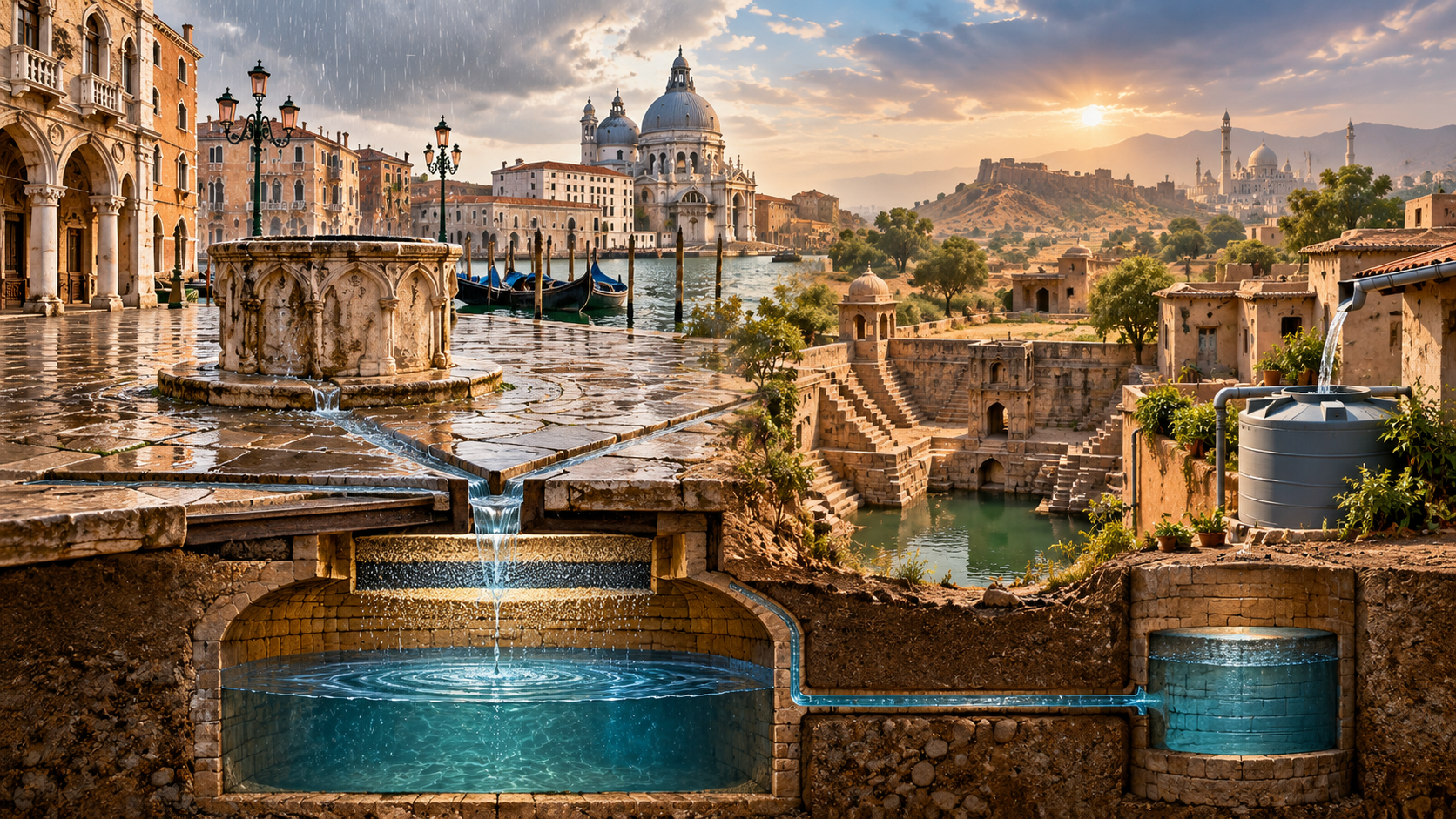
Beneath the marble-paved squares and cobbled alleys at the heart of Venice lies an extraordinary example of human adaptation.
Venice is a city surrounded by water, yet for centuries its greatest challenge was access to fresh water. Its historic response was not simply to search for water elsewhere. Venetians developed a system for capturing, filtering and storing rainwater within the city itself.
That history offers a compelling question for Pakistan:
What can an old water system teach a country facing a very different, but increasingly urgent, water challenge?
01 — Venice: A City Surrounded by Water
Venice's geography created a remarkable contradiction.
The lagoon provided water everywhere around the city, but the surrounding saltwater could not serve as a dependable source of freshwater for ordinary domestic use.
Academic research describes the Venetian “wells” as something quite different from conventional groundwater wells. They were sophisticated rainwater cisterns: systems designed to capture, filter and store rainfall. :contentReference[oaicite:2]{index=2}
The system became increasingly systematic from the medieval period onward and was adapted to Venice's very specific geography and urban form. By the late eighteenth century, the city had more than 5,000 Venetian-style wells/cisterns. :contentReference[oaicite:3]{index=3}
The key idea
Venice did not create freshwater.
It captured the rain that was already falling.
That distinction matters.
The visual story — in words
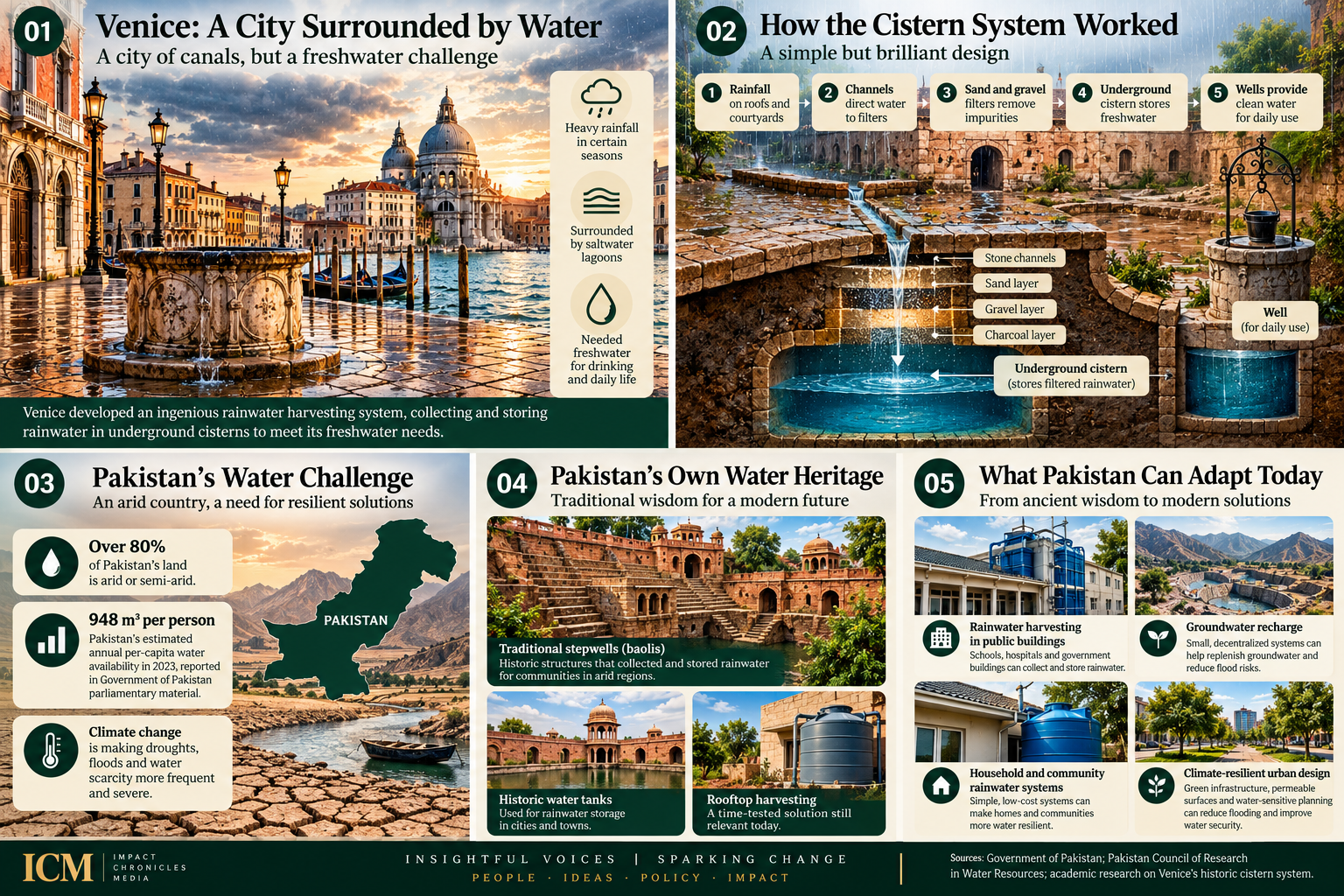
For readers who cannot access the infographic visually, its five panels can be understood as follows:
Panel 01 — Venice: A City Surrounded by Water
The first panel shows historic Venice during rainfall, with a stone well in the foreground and the lagoon beyond. The central idea is the contrast between a city surrounded by water and its historic dependence on freshwater collection and storage.
Panel 02 — How the Cistern System Worked
The second panel shows a simplified sequence:
Rainfall → channels → filtration → underground cistern → well
Rainwater collected from paved surfaces and rooftops was directed toward underground storage spaces. Filtration through sand formed part of the historic system before water accumulated in the central well shaft. The cisterns were designed specifically to separate stored freshwater from the surrounding lagoon environment. :contentReference[oaicite:4]{index=4}
Panel 03 — Pakistan's Water Challenge
The third panel places Pakistan at the centre of the story.
Government of Pakistan material reports annual per-capita water availability of approximately 948 cubic metres in 2023, below the 1,000 cubic-metre threshold commonly used in that material for water scarcity, with approximately 899 cubic metres estimated for 2025. :contentReference[oaicite:5]{index=5}
Pakistan's Ministry of Climate Change also identifies substantial climate vulnerability, including more frequent and severe droughts and floods, while noting that more than 80 percent of the country's territory lies in arid and semi-arid zones. :contentReference[oaicite:6]{index=6}
Panel 04 — Pakistan's Own Water Heritage
The fourth panel shifts the focus from Venice to Pakistan.
The important lesson is not that Pakistan lacks traditional water knowledge.
Pakistan already has a long architectural and cultural history of water storage, harvesting and stepped water structures. The Department of Archaeology and Museums' heritage database itself uses “Baoli (Stepped Well)” as a recognized heritage category. :contentReference[oaicite:7]{index=7}
The question, therefore, is not whether Pakistan has water wisdom.
It is whether we can recover, adapt and connect that wisdom to present-day climate needs.
Panel 05 — What Pakistan Can Adapt Today
The final panel presents practical possibilities:
Rainwater harvesting in public buildings
Schools, hospitals, government offices and other public buildings can incorporate collection and storage systems.
Groundwater recharge
Small, decentralized recharge measures can help retain rainfall locally and reduce pressure on groundwater where local geology and water quality conditions make recharge appropriate.
Household and community systems
Simple rainwater collection can improve local water resilience when properly designed, maintained and matched to safe uses.
Climate-resilient urban design
Permeable surfaces, better drainage, green infrastructure and water-sensitive planning can help cities manage intense rainfall while improving local water security.
02 — How the Cistern System Worked
The brilliance of Venice's historic system was its integration with the city itself.
The paved surface around a Venetian-style well was designed so that rainwater could enter drainage channels. The water travelled through underground galleries and filtered through sand. An impermeable clay lining helped retain the collected rainwater and limit infiltration of surrounding saline water. The filtered water then accumulated in a central shaft from which it could be drawn. :contentReference[oaicite:8]{index=8}
It was therefore not just a tank.
It was an urban water system.
Architecture, drainage, filtration, storage, maintenance and public administration were connected.
That is one of the most important lessons for a modern climate conversation.
Water infrastructure does not have to begin with a giant structure.
Sometimes it begins with the way a street, roof, courtyard or public space is designed.
03 — Pakistan's Water Challenge
Pakistan's water challenge is not identical to Venice's.
That distinction is important.
Venice developed rainwater cisterns in response to its lagoon environment and lack of readily available freshwater within the city. Pakistan, by contrast, has a large and diverse river system, groundwater resources, glaciers, monsoon rainfall and major agricultural demand.
Yet water availability per person has declined sharply over time.
Government of Pakistan material reports a fall from approximately 5,260 cubic metres per person in 1951 to 1,102 in 2017, 948 in 2023, and an estimated 899 in 2025. :contentReference[oaicite:9]{index=9}
This decline places greater importance on conservation, efficiency, groundwater management, recharge and local water storage.
Climate change adds another layer of uncertainty.
Pakistan's National Climate Change Policy identifies the country's dependence on monsoon rainfall and the glacier-fed Indus Basin as important elements of its vulnerability. It also highlights changing rainfall patterns and greater risks from floods and droughts. :contentReference[oaicite:10]{index=10}
The result is a difficult combination:
too much water at some times, too little at others, and growing pressure on the water available between those extremes.
A number can tell only part of the story
A national water statistic is important.
But the lived experience of water scarcity is local.
A household may struggle with unreliable municipal supply.
A farmer may face declining groundwater levels.
A city may experience flooding during intense rainfall while still struggling with water supply during dry periods.
A community may possess a historic water structure that has fallen into disuse.
Climate resilience therefore cannot be measured only through large reservoirs or national supply figures.
It must also be understood at the level of homes, streets, neighbourhoods, institutions, watersheds and communities.
04 — Pakistan's Own Water Heritage
The most important lesson from Venice may be that sustainability often begins with knowledge of place.
Pakistan does not need to copy Venice.
It can learn from the principle behind Venice and apply it to its own geography, architecture and traditions.
Traditional stepped wells, baolis, tanks and other local water structures represent forms of knowledge developed in response to particular climates, materials and community needs.
Modern technology does not have to replace that knowledge.
It can strengthen it.
A restored heritage structure can also become an educational site.
A school can become a rainwater-harvesting demonstration site.
A public building can become a small-scale water conservation laboratory.
A neighbourhood can combine rooftop collection with safe storage and appropriate groundwater recharge.
This is where heritage and climate adaptation can meet.
05 — What Pakistan Can Adapt Today
The most useful lesson from Venice is not to reproduce a medieval system.
It is to recover a way of thinking.
Start with rain where it falls
Rainwater harvesting can reduce the amount of rainfall that immediately becomes runoff and can create opportunities for local storage or other appropriate uses.
Pakistan's National Climate Change Policy places water among the sectors requiring climate adaptation and identifies measures aimed at strengthening resilience. :contentReference[oaicite:11]{index=11}
Design buildings as part of the water system
Roofs, drains, courtyards, tanks and recharge areas should not be considered separate from urban water management.
Building design can help determine whether rainfall becomes:
runoff, flooding, storage, recharge — or waste.
Make public institutions demonstrations of practice
Schools, hospitals, mosques, parks and government buildings can demonstrate practical water conservation.
A child who sees rainfall collected and stored is learning something different from a child who only reads about water conservation in a textbook.
Protect groundwater while promoting recharge
Groundwater recharge is not simply a matter of putting water into the ground.
The location, geology, quality of the water, contamination risk and local aquifer conditions all matter.
Pakistan's water research institutions have highlighted groundwater recharge and sustainable aquifer management as important areas for addressing water stress. :contentReference[oaicite:12]{index=12}
Reconnect climate policy with local governance
A national policy can establish direction.
But implementation happens locally.
Municipal authorities, development agencies, schools, communities, architects, heritage institutions and citizens all have different roles to play.
The challenge is therefore not merely technological.
It is also one of governance, coordination and public participation.
Venice Is Not a Blueprint. It Is a Question.
There is a temptation whenever an old system works well to declare it a model for the future.
That would be too simple.
Pakistan and Venice have different climates, hydrology, population patterns, urban forms, water demands and institutional arrangements.
The value of Venice lies elsewhere.
It demonstrates that a city can adapt its built environment to capture and manage water locally.
It demonstrates that infrastructure can be decentralized.
It demonstrates that water management can be embedded into architecture.
And it demonstrates that communities and institutions can develop systems around the natural characteristics of their surroundings. :contentReference[oaicite:13]{index=13}
The lesson for Pakistan is therefore not:
“Build Venice.”
It is:
“Think locally about water.”
From Ancestral Wisdom to Climate Resilience
Pakistan is already facing a future in which water security will increasingly depend on choices made today.
Large-scale water infrastructure will remain part of the national water conversation.
But resilience can also be built at a much smaller scale.
A roof.
A courtyard.
A school.
A mosque.
A park.
A restored baoli.
A recharge area.
A neighbourhood.
A city.
Together, these small systems can become part of a larger culture of water stewardship.
That is perhaps the most valuable bridge between ancient Venice and modern Pakistan:
The future of water security may depend not only on finding more water, but on learning how to value, capture, manage and share the water that already comes to us.
Conclusion
Venice's historic cisterns remind us that sustainability does not always begin with a new invention.
Sometimes it begins with paying attention to the environment around us.
For Pakistan, the opportunity is not to romanticize the past or to treat traditional systems as substitutes for modern infrastructure.
It is to combine traditional knowledge, contemporary science, climate adaptation, responsible urban design and accountable water governance.
The question is therefore no longer simply how much water Pakistan has.
It is also:
How wisely can we receive it, store it, recharge it, conserve it and govern it?
Perhaps somewhere between Venice's underground cisterns and Pakistan's forgotten water structures lies part of that answer.
Accessibility note
This picture story is designed so that its central information does not depend on seeing the images.
The featured illustration has alternative text, a caption and an expanded visual description. The infographic is accompanied by a full text explanation of its five panels. The article itself remains available as structured text and can be listened to using the ICM accessibility controls.
By Aysal Elham
Climate Governance Analyst / MPhil Media Studies
impactchroniclesmedia@outlook.com
Journalism should be reachable by everyone.
This story is presented as accessible, text-first journalism. Images include alternative text and visual descriptions where provided, the article is structured with meaningful headings, and a browser-based listening option is available where supported. Future ICM audio and video editions will be developed with captions, transcripts and descriptions of important visual information.